May 27, 2026

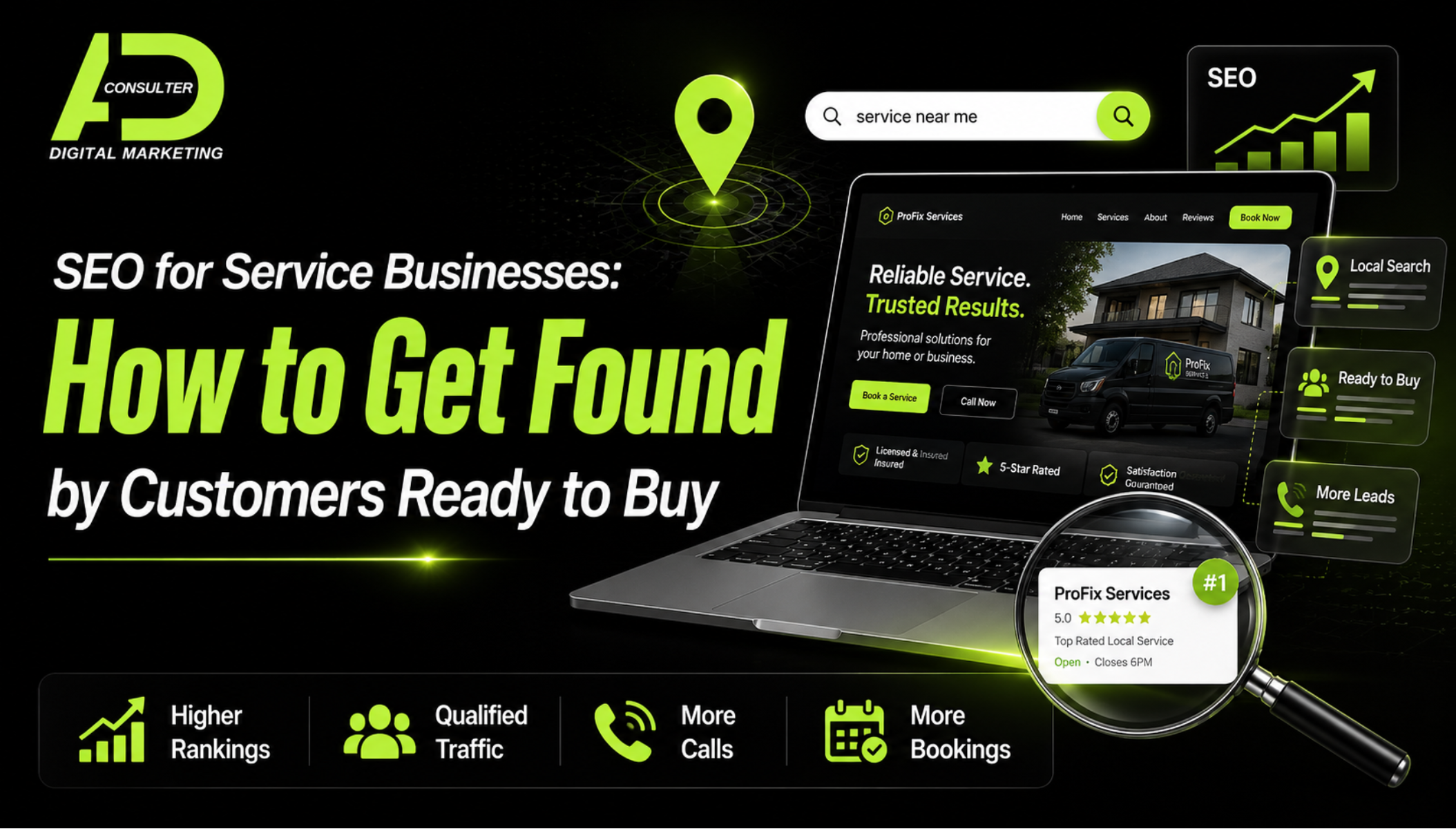
SEO for Service Businesses: Get Found by Ready-to-Buy Customers
Service businesses live and die by visibility. If customers cannot find you when they need help, they will find someone else. That is true whether you are a contractor, medical provider, consultant, law firm, home service company, creative agency, wellness brand, restaurant group, real estate professional, or B2B provider. People search when they have a problem, a question, or a buying intent. SEO helps your business show up at that exact moment.
The challenge is that many service businesses treat SEO like a checklist instead of a growth system. They add a few keywords, publish a couple of blogs, update a title tag, and hope Google does the rest. But strong SEO is more strategic than that. It connects keyword research, website structure, service pages, technical performance, content creation, internal linking, backlinks, local visibility, and conversion strategy.
At AdConsulter, SEO is positioned as a revenue-focused marketing channel, not just a traffic tactic. The goal is not simply to rank for random keywords. The goal is to bring in the right traffic: people who are actively searching for what your business offers and are more likely to become leads.
This guide breaks down how SEO for service businesses works and how to build a strategy that helps customers find you when they are ready to buy.
Why SEO Matters So Much for Service Businesses
When someone searches for a service, they usually have a problem they want solved. That search might be broad, such as “best marketing agency for small business,” or specific, such as “SEO company for service businesses.” It might be local, such as “website designer near me,” or educational, such as “why is my website not getting leads.”
Each search represents intent. Some people are just learning. Some are comparing options. Some are ready to book. SEO helps you create content and pages for each stage of that journey.
The biggest advantage of SEO is that it compounds over time. Paid ads stop when the budget stops. Social media posts can disappear quickly in the feed. SEO content can continue attracting traffic, leads, and authority long after it is published, especially when it is updated and supported with internal links.
For service businesses with limited time and budget, that long-term value matters.
Start With the Right Keywords, Not the Most Obvious Keywords
Many businesses want to rank for the biggest keyword in their industry. The problem is that the biggest keyword is not always the best keyword. It may be too competitive, too broad, or too disconnected from buying intent.
A smart SEO strategy starts with keyword research that balances volume, competition, relevance, and intent. For example, a business may want to rank for “marketing,” but that keyword is too broad. “Digital marketing agency for small businesses” is more specific. “SEO services for service businesses” is even more focused. “Website design agency for small business lead generation” tells you even more about the customer’s intent.
AdConsulter’s SEO Marketing service starts with keyword and competitor research to identify high-intent search terms your ideal customers use. That matters because SEO should not be built around vanity keywords. It should be built around searches that can turn into business.
The best keywords often sit in the middle: specific enough to attract qualified visitors, but broad enough to support meaningful traffic.
Build Dedicated Service Pages
For service businesses, service pages are some of the most important SEO assets on the website. Each page should focus on one main offer and answer the buyer’s most important questions.
A strong service page should include what the service is, who it is for, what problems it solves, what is included, how the process works, why your business is different, and what the visitor should do next.
AdConsulter separates its services into individual pages, including Social Media Marketing, SEO Marketing, Email Marketing, Website Design, and All-Inclusive Marketing. That structure gives each page a clear SEO purpose and helps visitors find the specific information they need.
If your website only has one generic “services” page, you may be missing opportunities to rank for more specific searches.
Match Content to the Buyer Journey
Not every website visitor is ready to contact you immediately. Some are just becoming aware of a problem. Some know they need help but are comparing approaches. Others are actively looking for a provider.
Your SEO strategy should support all three stages.
Awareness content answers early questions. Examples include “Why is my website not ranking?” or “How often should a small business post on social media?”
Consideration content helps people compare solutions. Examples include “SEO vs paid ads for small businesses” or “Should I hire a marketing agency or freelancer?”
Decision content helps people choose. Examples include service pages, pricing pages, case studies, testimonials, and portfolio examples.
AdConsulter’s website already has a blog, service pages, pricing, portfolio, and a clear path to schedule a call. That creates multiple entry points for different types of visitors.
The stronger your content map, the easier it is for people to move from search to trust to action.
Optimize the Website Foundation
SEO does not work well on a weak technical foundation. A slow, confusing, poorly structured website makes it harder for search engines to crawl and harder for visitors to convert.
Before publishing dozens of blogs, make sure the website itself is healthy. That means fast loading speeds, mobile-friendly layouts, clean URL structure, proper metadata, optimized images, clear headings, and no major crawl errors.
AdConsulter’s Website Design service highlights SEO-ready architecture, mobile optimization, fast loading speeds, and conversion-driven layouts. That is exactly how businesses should think about their websites. SEO should not be added after the site is built. It should be considered from the beginning.
A beautiful website that search engines cannot understand will struggle. A search-optimized website that visitors cannot navigate will also struggle. You need both.
Use Internal Linking to Strengthen Your SEO
Internal linking is one of the most overlooked SEO tools for service businesses. It helps visitors move through your site, and it helps search engines understand which pages are important.
For example, a blog about website conversions should link to your website design service. A blog about ranking higher should link to your SEO service. A blog about nurturing leads should link to your email marketing service. A blog about connected marketing should link to your all-inclusive marketing package.
Internal links also help distribute authority across the site. If one blog performs well, links from that blog can support related service pages.
A strong internal linking strategy should feel natural. Do not force links into every sentence. Place links where they help the reader take the next useful step.
Create Location and Industry Relevance
Many service businesses serve specific areas, industries, or customer types. Your SEO strategy should reflect that.
If you are based in a certain city, your website should clearly communicate that. If you specialize in certain industries, create content and service sections that speak directly to those audiences. If you work nationally, explain how your process supports clients across locations.
AdConsulter is based in Stamford, CT and serves clients through digital marketing services that can support businesses across different industries. Its site mentions industries like e-commerce, SaaS, healthcare, fashion, hospitality, and professional services. That type of positioning helps prospects understand whether the agency fits their world.
The more specific your content is, the more relevant it becomes to the right people.
Publish Blogs That Support Your Services
Blogs should not be random. Every blog should support a service, answer a real search question, or help move people closer to working with you.
For a service business, the best blog topics often come from customer questions. What do prospects ask on calls? What objections come up? What do people misunderstand about your service? What problems do they try to solve before they hire you?
A blog about “how to improve website conversions” can support a website design service. A blog about “email sequences every small business needs” can support email marketing. A blog about “how to build authority with backlinks” can support SEO. A blog about “what full-stack digital marketing means” can support an all-inclusive package.
This is how SEO content becomes useful. It is not just written to rank. It is written to educate and convert.
Build Backlinks That Make Sense
Backlinks are links from other websites to yours. They can help build authority, but quality matters far more than quantity. Spammy backlink tactics can damage credibility and do little for real growth.
For service businesses, backlink opportunities can come from partnerships, guest content, community involvement, industry directories, podcast features, vendor relationships, case studies, and helpful resources worth sharing.
AdConsulter includes backlink outreach as part of its SEO approach and all-inclusive plans. That is important because backlinks are not a one-time task. They require consistent effort, relevance, and quality control.
A smart backlink strategy should be connected to the rest of the marketing plan. If you publish strong blogs, showcase portfolio work, create helpful guides, and stay active across channels, you create more reasons for other websites to link back to you.
Track the Right SEO Metrics
SEO takes time, but that does not mean you should operate blindly. You need to track progress.
Important metrics include keyword movement, organic traffic, impressions, click-through rate, pages bringing in traffic, conversions from organic search, backlinks earned, and form submissions. Rankings matter, but leads matter more.
AdConsulter’s SEO service includes performance tracking and monthly reporting, with insight into keyword movement, organic traffic trends, and backlinks. That type of reporting helps businesses understand what is improving and what needs adjustment.
SEO is not something you set once and forget. It needs monitoring, testing, updating, and refinement.
Connect SEO With Social, Email, and Website Strategy
SEO becomes more powerful when it is not isolated. A blog can become social media content. A service page can support paid ads. An SEO guide can become an email campaign. A high-performing keyword can influence website copy. A frequently asked customer question can become a reel, blog, and email.
This is where connected marketing creates momentum. AdConsulter’s All-Inclusive Marketing service is built around this idea: social media, SEO, website updates, email campaigns, and reporting working together instead of living in separate silos.
For service businesses, that alignment is a major advantage. You do not want your SEO saying one thing, your social media saying another, and your website failing to support either. You want one strategy, one voice, and one clear path to conversion.
Common SEO Mistakes Service Businesses Make
One mistake is focusing only on the homepage. Your homepage is important, but it cannot rank for every service, question, and buyer intent.
Another mistake is publishing blogs without internal links. If your blog content does not point visitors toward relevant services, you are missing conversion opportunities.
A third mistake is ignoring technical SEO. Slow speed, poor mobile design, duplicate metadata, and broken links can hold back performance.
Another mistake is giving up too soon. SEO typically takes time, especially in competitive industries. A few weeks of effort is not enough to judge a strategy.
Finally, many businesses write for themselves instead of their customers. SEO content should speak to what buyers are searching, asking, comparing, and worrying about.
Final Thoughts: SEO Should Bring You Better Leads, Not Just More Traffic
The real goal of SEO for service businesses is not to attract everyone. It is to attract the right people. People who need your service. People who understand the problem. People who are searching with intent. People who are more likely to book a call, request a quote, or start a conversation.
That requires more than keywords. It requires a strong website, clear service pages, helpful content, internal linking, authority building, reporting, and a strategy that connects SEO to the rest of your marketing.
If your business wants to get found by customers who are ready to buy, explore AdConsulter’s SEO Marketing, Website Design, and All-Inclusive Marketing services.
Ready to find out what your SEO could be doing better? Schedule a free 15-minute strategy call with AdConsulter and let’s build a search strategy that brings in stronger leads.
FAQs
Why is SEO important for service businesses?
SEO helps service businesses show up when potential customers are actively searching for solutions. It can drive qualified traffic, build trust, support lead generation, and create long-term visibility.
How long does SEO take for a service business?
SEO often takes several months to show stronger movement, depending on competition, website condition, content quality, and authority. Consistent optimization, content creation, and reporting are key.
What pages should a service business optimize first?
Start with the homepage, core service pages, contact page, and any high-intent location or industry pages. Then build blog content that supports those services and answers customer questions.
.png)