
May 27, 2026

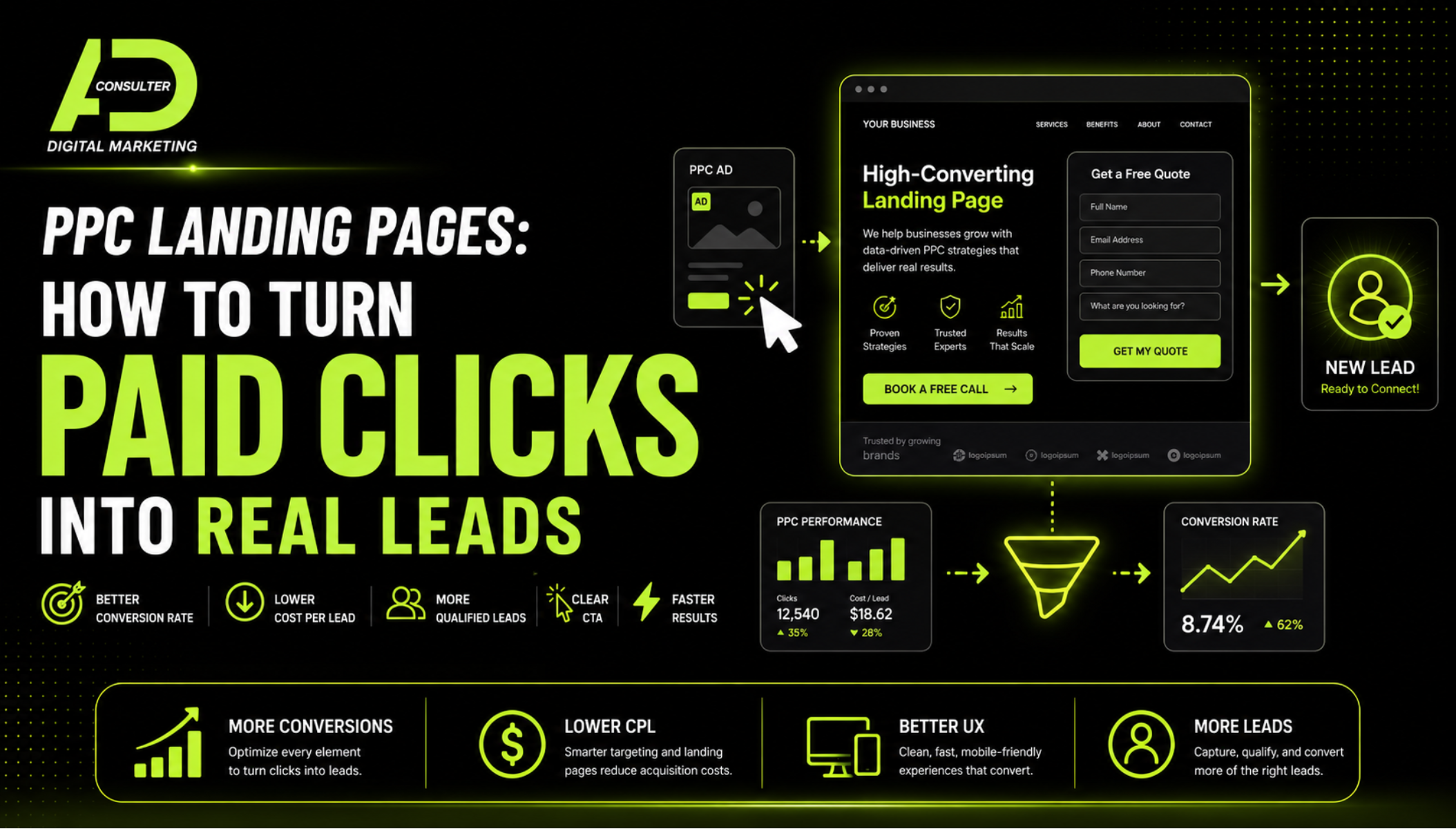
PPC Landing Pages: How to Turn Paid Clicks Into Real Leads
Paid ads can get people to your website fast. But traffic alone does not grow a business.
The real goal is not just to get clicks. The goal is to turn those clicks into leads, calls, purchases, booked appointments, quote requests, or qualified conversations. That is where PPC landing pages become one of the most important parts of your paid advertising strategy.
A PPC landing page is the page someone lands on after clicking a paid ad. It should be built around one campaign, one audience, one offer, and one clear action. When the landing page is strong, it helps your ad budget work harder. When the landing page is weak, even a great ad campaign can underperform.
Many small businesses make the same mistake: they send paid traffic to their homepage.
A homepage is important, but it usually has too many jobs. It introduces the brand, lists services, links to different pages, shares general information, and speaks to multiple types of visitors. A PPC landing page has one job: convert the specific person who clicked the ad.
At AdConsulter, marketing is built around strategy, precision targeting, and full-stack digital marketing. That matters because PPC does not work in a vacuum. Paid ads need strong landing pages, clear website structure, email follow-up, analytics, and a conversion strategy behind them.
If your business is spending money on ads but not seeing enough leads, the issue may not be the ad itself. It may be what happens after the click.
What Makes a PPC Landing Page Different?
A regular website page gives information. A PPC landing page drives action.
That difference matters because paid traffic costs money. Every visitor who clicks your ad uses part of your budget. If they land on a confusing page, wait too long for it to load, or cannot figure out what to do next, you lose money.
A strong PPC landing page should match the ad, speak directly to the audience, explain the offer clearly, build trust quickly, and make the next step easy.
For example, if your ad promotes website design, the landing page should focus on website design. It should not make the visitor search through your entire services menu. If your ad promotes SEO support, the landing page should explain how your SEO service helps customers get found. If your ad promotes a free strategy call, the page should make scheduling that call the obvious next step.
AdConsulter’s Website Design service is a strong internal fit here because landing pages need more than good visuals. They need responsive design, mobile optimization, SEO-friendly structure, and layouts built to turn visitors into customers.
Start With Message Match
Message match means the landing page continues the same promise made in the ad.
If your ad says, “Get More Leads With a Website Built to Convert,” the landing page headline should reinforce that idea. If your ad says, “SEO Marketing for Small Businesses,” the landing page should talk about SEO, not general branding.
When the ad and landing page do not match, visitors feel disconnected. They clicked expecting one thing and landed somewhere that feels different. That moment of confusion can cause them to leave.
Message match should show up in the headline, subheading, visuals, CTA, and page content. The visitor should feel like they are in the right place within seconds.
For AdConsulter, this could mean creating different PPC landing pages for different offers:
A website design landing page for businesses that need a stronger site.
An SEO landing page for businesses that want more search visibility.
An email marketing landing page for businesses that need better follow-up.
An all-inclusive marketing landing page for businesses that want one connected strategy.
Each page should be specific, not generic.
Keep the Hero Section Clear
The hero section is the first section visitors see. It should answer three questions quickly:
What is this?
Who is it for?
What should I do next?
A weak landing page hero might say, “Digital Solutions for Modern Businesses.” That sounds nice, but it does not say much.
A stronger version might say, “Turn Paid Clicks Into Real Leads With a Website Built to Convert.”
That headline tells the visitor what the page is about and why it matters.
The subheading should add more detail without becoming too long. For example:
“AdConsulter helps small businesses create conversion-focused landing pages, websites, and marketing systems that turn traffic into booked calls, inquiries, and revenue.”
Then the CTA should be direct:
Schedule Your Free 15-Minute Strategy Call
The hero section should not make people work. It should make the next step feel obvious.
Remove Distractions
A PPC landing page should be focused.
That does not mean it has to be plain or boring. It means every section should support the conversion goal.
Too many navigation links, popups, buttons, social icons, unrelated offers, or competing CTAs can distract visitors. If someone clicks an ad for website design, the landing page should not immediately push them toward six different services, a blog archive, and every social platform.
Keep the page tight.
You can still include internal links where they help the reader. For example, a landing page about PPC could naturally mention Website Design, Email Marketing, or All-Inclusive Marketing. But the primary action should remain clear.
The less friction, the better.
Build the Page Around One Audience
One landing page cannot speak perfectly to everyone.
A restaurant owner, dentist, contractor, e-commerce founder, law firm, and SaaS company may all need marketing, but their problems are different.
A restaurant may care about reservations, local awareness, online ordering, and repeat customers.
A service business may care about quote requests, booked appointments, and local SEO.
An e-commerce brand may care about product visibility, email flows, conversion rate, and repeat purchases.
A professional service provider may care about credibility, trust, education, and consultation bookings.
If your ad campaign targets a specific type of customer, the landing page should speak to that customer directly.
This is where AdConsulter’s full-service model becomes useful. Since AdConsulter works across services like SEO, social media, email marketing, website design, and PPC, different campaigns can have different landing pages that all connect back to the same larger strategy.
Specific pages usually convert better than general pages.
Explain the Offer Clearly
Your landing page needs to explain what the visitor gets.
Do not assume people understand your offer just because they clicked the ad.
If the page is for PPC landing page support, explain what is included:
Campaign-focused landing page strategy.
Conversion-driven copywriting.
Mobile-optimized design.
Clear call-to-action placement.
Lead form setup.
Email follow-up recommendations.
Tracking and analytics.
Connection to paid ads, SEO, and website strategy.
If the page is for All-Inclusive Marketing, explain how social media, SEO, web support, email, link building, and PPC work together.
If the page is for SEO Marketing, explain how keyword research, technical fixes, content, and backlink strategy help bring in better search traffic.
Clarity sells. Confusion kills conversions.
Use Trust Signals Near the CTA
People need reasons to trust you before they take action.
Trust signals can include testimonials, portfolio work, case studies, client results, reviews, process explanations, years of experience, industry expertise, or recognizable brands.
AdConsulter’s Portfolio is useful here because it shows examples of digital marketing work across SEO, social media, email, PPC, website design, and lead generation. A landing page should pull from that credibility.
Trust signals work best when placed near decision points.
For example, before asking someone to schedule a call, include a short proof section:
“See how AdConsulter has helped businesses improve visibility, generate leads, and turn marketing into revenue.”
Then link to the Portfolio.
The visitor should not feel like they are taking a risk. They should feel like they are taking a smart next step.
Make the CTA Specific
A generic button like “Submit” is weak.
A better CTA tells the visitor exactly what they are doing.
Examples include:
Schedule Your Free Strategy Call
Request a Website Quote
Get My Free Marketing Review
Start Growing Today
Build My Landing Page
Talk to a Marketing Strategist
For AdConsulter, the strongest CTA is simple:
Schedule Your Free 15-Minute Strategy Call
That CTA works because it is low-pressure and clear. The visitor knows they are not being forced into a purchase. They are starting a conversation.
Use the CTA more than once on the landing page. Place it near the top, after key proof sections, and at the end.
Keep Forms Short
Landing page forms should be easy to complete.
The more information you ask for, the more friction you create. For most PPC landing pages, you only need the basics:
Name.
Email.
Phone number.
Business name.
Short message.
You can collect more details later.
If the form feels too long, visitors may leave. This is especially true on mobile, where typing is slower and patience is lower.
Also make sure the form works. Test it before launching ads. Make sure submissions go to the right inbox. Make sure confirmation messages are clear. Make sure the follow-up process is ready.
A broken or confusing form can waste an entire ad campaign.
Connect Landing Pages to Email Follow-Up
PPC does not end when someone fills out a form.
That is when follow-up begins.
If a lead submits their information and hears nothing for hours or days, momentum fades. A strong landing page should connect to an email follow-up system.
AdConsulter’s Email Marketing service fits directly into this. Email campaigns can nurture leads after they click an ad, submit a form, request information, or book a call.
A simple follow-up sequence might include:
Confirmation email.
Introduction to the business.
Service explanation.
Portfolio or proof.
Common questions.
Reminder to schedule or confirm the call.
This helps make sure paid leads do not go cold.
Design for Mobile First
Many ad clicks happen on mobile.
If your landing page does not work well on a phone, you are losing conversions.
Mobile landing pages should load quickly, use large readable text, have easy-to-tap buttons, keep forms short, and stack content cleanly. Avoid crowded layouts, tiny text, oversized images, and heavy animations.
A mobile landing page should feel smooth.
AdConsulter’s Website Design service emphasizes mobile-optimized, responsive websites. That is critical for PPC because paid traffic is too valuable to waste on a page that only looks good on desktop.
Before launching any campaign, test the landing page on your phone.
Track the Right Metrics
A PPC landing page should be measured.
Do not only look at clicks. Clicks tell you people were interested in the ad. They do not tell you whether the page worked.
Track:
Landing page views.
Conversion rate.
Form submissions.
Booked calls.
Cost per lead.
Bounce rate.
Time on page.
Button clicks.
Lead quality.
Revenue from leads.
The goal is not just cheaper clicks. The goal is better leads.
AdConsulter’s broader marketing approach includes performance tracking and reporting, which is essential for improving campaigns over time. If a landing page gets traffic but no conversions, the page needs work. If leads come in but do not close, the offer or follow-up may need work.
Data helps you improve the system.
Common PPC Landing Page Mistakes
The first mistake is sending ad traffic to a generic homepage.
The second mistake is weak message match between the ad and landing page.
The third mistake is too many distractions.
The fourth mistake is unclear copy.
The fifth mistake is a weak CTA.
The sixth mistake is a long or broken form.
The seventh mistake is poor mobile design.
The eighth mistake is no email follow-up.
The ninth mistake is not tracking conversions properly.
Most PPC problems are not solved by spending more money. They are solved by fixing the system around the ad.
A Simple PPC Landing Page Structure
A strong landing page can follow this structure:
Hero section with a clear headline, subheading, and CTA.
Problem section that explains what the visitor is struggling with.
Solution section that introduces your offer.
Service breakdown that explains what is included.
Trust section with proof, portfolio, or results.
Process section that shows what happens next.
FAQ section that removes hesitation.
Final CTA that invites them to schedule a call.
For AdConsulter, the final CTA should point to the free 15-minute strategy call.
This structure keeps the page focused while giving visitors enough information to act.
Final Thoughts
Paid ads can bring people to your business, but landing pages turn that traffic into opportunity.
A strong PPC landing page should match the ad, speak to one audience, explain one offer, build trust, remove distractions, work beautifully on mobile, and make the next step obvious.
If your business is getting clicks but not enough leads, do not just increase the ad budget. Fix the page. Strengthen the offer. Improve the CTA. Add follow-up. Track what matters.
AdConsulter can help connect those pieces through Website Design, Email Marketing, SEO Marketing, and All-Inclusive Marketing.
Ready to turn more paid clicks into real leads? Schedule your free 15-minute strategy call with AdConsulter.
FAQs
What is a PPC landing page?
A PPC landing page is a focused page built for paid ad traffic. It is designed around one campaign, one audience, one offer, and one conversion goal.
Should PPC ads go to my homepage?
Sometimes, but a dedicated landing page is usually better. Homepages often have too many goals, while landing pages are built to convert specific traffic.
How can AdConsulter help with PPC landing pages?
AdConsulter can help with conversion-focused website design, landing page strategy, PPC alignment, email follow-up, analytics, and full-stack marketing support that turns paid traffic into leads.
.png)


