May 27, 2026

What Is Full-Stack Digital Marketing? A Guide for Small Businesses
Small business marketing often becomes scattered.
One person handles social media. Someone else builds the website. Another vendor runs ads. Blogs get written when there is extra time. Email marketing happens only when there is a promotion. SEO gets treated like a separate project. Reporting lives in five different places.
The business is doing marketing, but nothing feels connected.
That is where full-stack digital marketing becomes valuable.
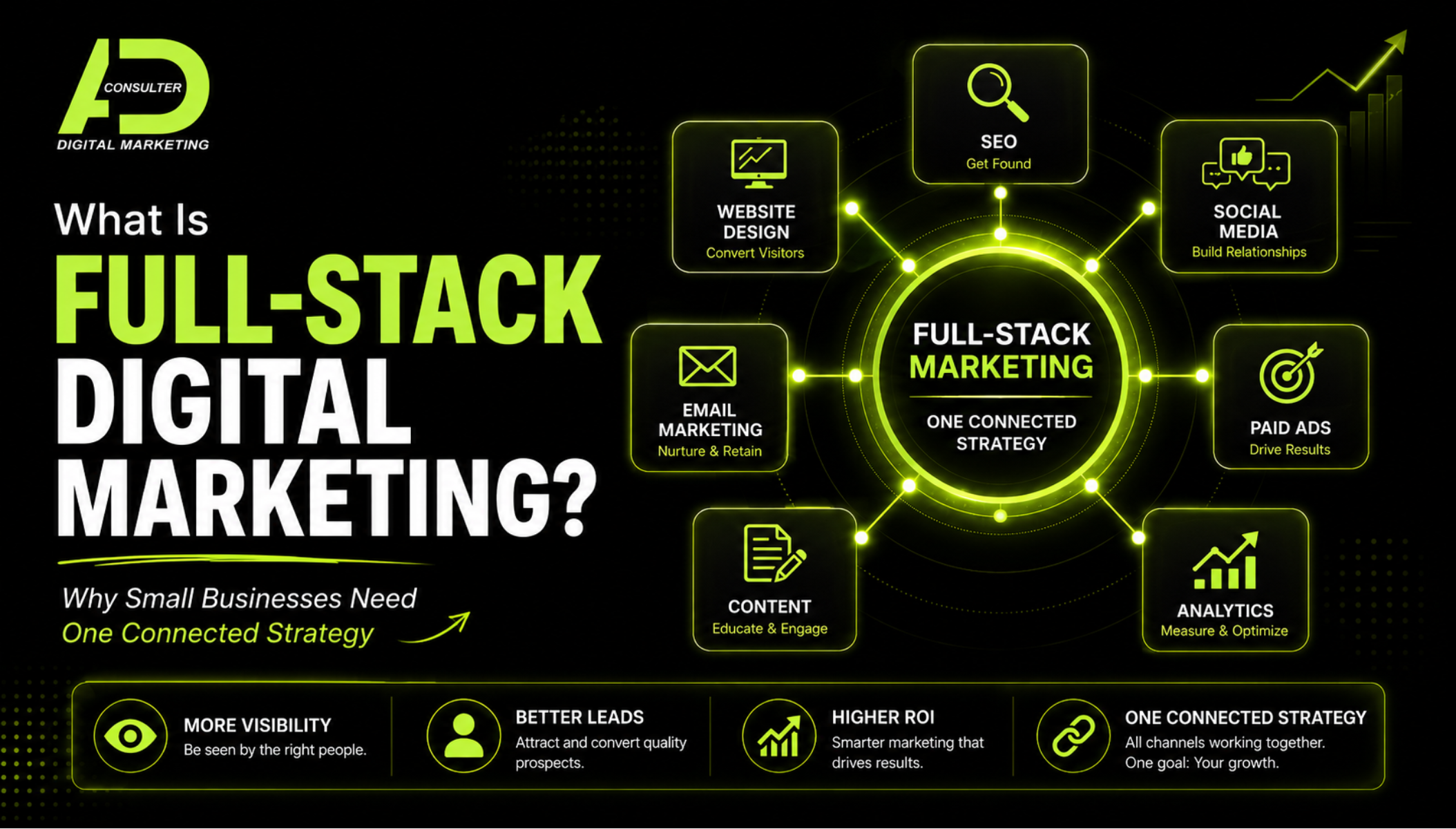
Full-stack digital marketing means your website, SEO, social media, email marketing, PPC, content, analytics, and automation all work together under one strategy. Instead of treating every channel as a separate task, full-stack marketing connects the entire customer journey.
Because customers do not experience your business in pieces.
They might find you on Google, check your Instagram, visit your website, read a blog, look at pricing, join your email list, and book a call two weeks later. If every part of that journey feels disconnected, trust breaks down. If every part feels aligned, your marketing becomes much stronger.
At AdConsulter, the message is clear: marketing should turn into revenue. That does not happen from random posting, disconnected ads, or a website that looks nice but does not convert. It happens when every channel supports the same goal.
What Full-Stack Digital Marketing Actually Means
Full-stack digital marketing is a complete approach to online growth.
It includes strategy, branding, website design, search engine optimization, social media marketing, email marketing, PPC, content creation, link building, analytics, and ongoing optimization.
But the most important word is connected.
A business can have SEO, social media, email, and ads without having a full-stack strategy. The difference is whether those services are working together or operating separately.
For example, one blog topic can become:
A Google-ranking SEO blog.
A carousel post for Instagram.
A short-form video script.
An email newsletter.
A paid ad angle.
A landing page section.
A lead nurture email.
A LinkedIn post.
That is full-stack thinking. One strong idea becomes multiple assets across the customer journey.
Instead of creating more work, you create more leverage.
Why Small Businesses Struggle With Disconnected Marketing
Most small businesses are not struggling because they do not care about marketing. They are struggling because there are too many moving parts.
They need social media posts. They need SEO. They need a better website. They need email campaigns. They need Google visibility. They need paid ads. They need analytics. They need content. They need follow-up.
But they may not have a full internal marketing team.
So they patch things together.
A designer makes graphics. A freelancer writes blogs. A web developer edits the site. Someone on the team posts on social media. Ads are tested separately. Email gets ignored until there is a sale or announcement.
The result is usually inconsistent.
The website says one thing. Social media says another. Emails sound different. Ads push an offer that the landing page does not support. Blogs get traffic but do not connect to services. Reports show activity but not business growth.
Full-stack digital marketing solves this by giving every channel a job.
The Website Is the Center of the Strategy
Your website is the center of your digital marketing system.
Social media sends people there. SEO sends people there. Email sends people there. Ads send people there. Referrals often check it before contacting you.
If your website is weak, every channel suffers.
A strong website should explain what you do, who you help, why you are different, and what someone should do next. It should load quickly, work beautifully on mobile, include clear service pages, and make it easy to become a lead.
AdConsulter’s Website Design service focuses on responsive, mobile-optimized, SEO-friendly websites that showcase your brand and convert visitors into customers.
That is exactly what a full-stack strategy needs.
A website should not be a digital brochure. It should be a conversion tool.
SEO Creates Long-Term Visibility
SEO helps your business get found when people are already searching.
That makes it one of the most valuable parts of a full-stack marketing strategy. Instead of interrupting people, SEO puts your business in front of customers who are actively looking for answers, services, or solutions.
AdConsulter’s SEO Marketing service focuses on helping businesses rank higher, get found faster, and bring in the right traffic through smart, sustainable strategies.
In a full-stack system, SEO does not just live on the blog. It influences:
Website structure.
Service page copy.
Blog topics.
Internal linking.
Landing pages.
Content strategy.
Backlink outreach.
Local visibility.
Analytics reporting.
For example, if people are searching for “website design for small businesses,” that keyword can inform a service page, a blog post, a paid ad, an email topic, and a social media carousel.
SEO gives your marketing strategy direction because it shows what your audience is already looking for.
Social Media Builds Trust and Visibility
Social media helps your business stay visible, active, and relevant.
But social media should not exist only to fill a content calendar. It should support the larger business strategy.
AdConsulter’s Social Media Marketing helps businesses show up where customers already are, stay consistent, connect with their audience, and grow across the platforms that matter most.
In a full-stack strategy, social media can:
Repurpose SEO blogs.
Promote website pages.
Share client wins.
Educate customers.
Support launches.
Test messaging.
Drive traffic to landing pages.
Build brand recognition.
Warm up future leads.
The best social media content does not come from guessing. It comes from strategy.
If a blog performs well, turn it into social posts. If a social post gets high engagement, turn that idea into a blog. If customers ask the same question in comments or DMs, turn that question into an FAQ section on your website.
That is how channels start feeding each other.
Email Marketing Turns Attention Into Follow-Up
Traffic is great, but follow-up is where many businesses lose money.
Someone can find your website, read a blog, click an ad, or follow you on Instagram, but if they are not ready to buy today, what happens next?
That is where email marketing comes in.
AdConsulter’s Email Marketing helps businesses reach the right people at the right time, stay top of mind, nurture relationships, and drive engagement that leads to real conversions.
In a full-stack strategy, email supports every other channel.
SEO brings people in. Email keeps them warm.
Social media builds interest. Email deepens the relationship.
Paid ads create traffic. Email follows up.
Website forms capture leads. Email nurtures them.
Past clients go quiet. Email re-engages them.
Without email, you rely too much on people acting immediately. With email, you create a system that continues after the first click.
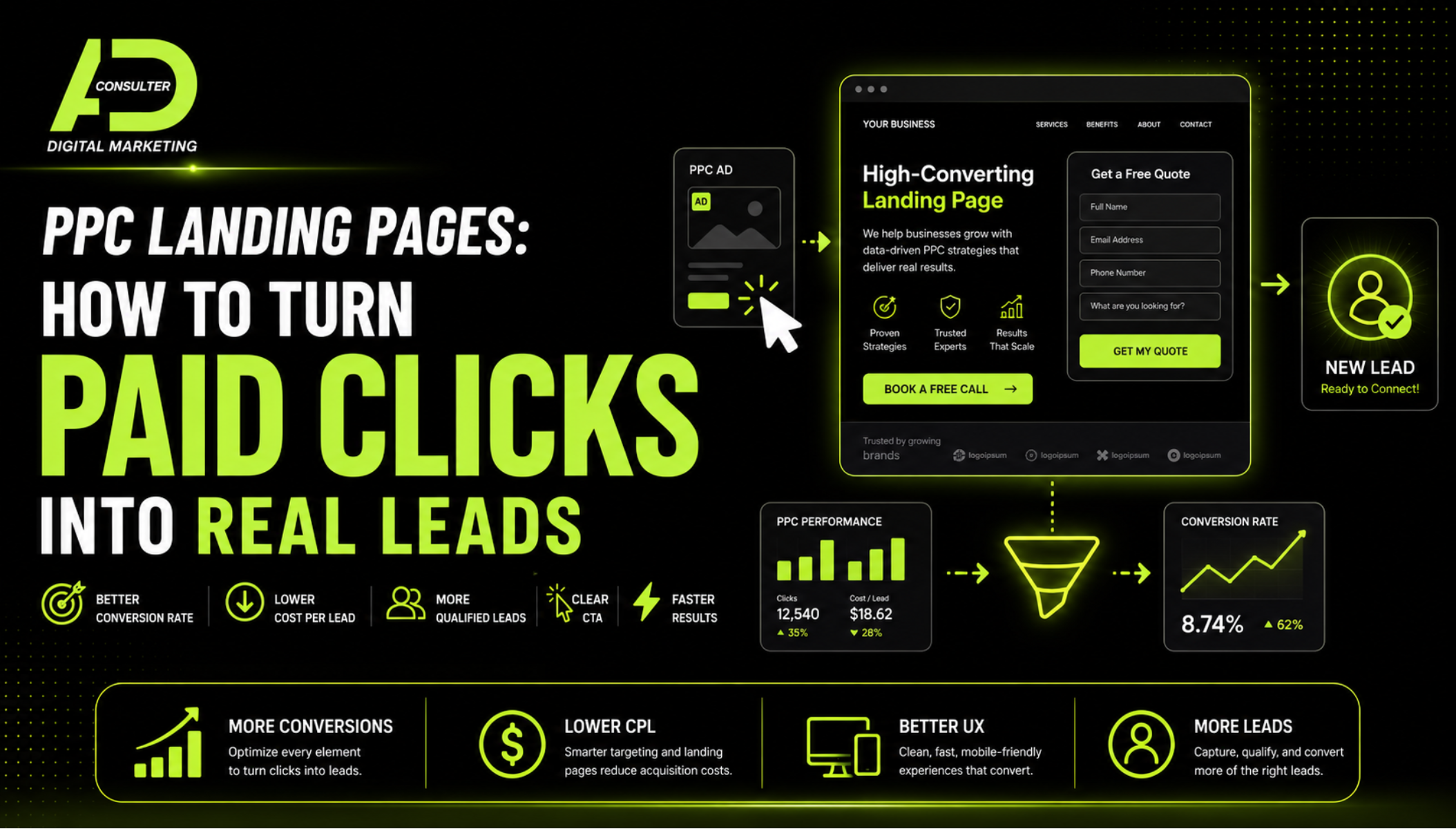
PPC Accelerates the Strategy
Paid advertising can be powerful, but it works best when the foundation is strong.
If your website is not ready, PPC can waste money. If your landing page is unclear, clicks will not convert. If you do not have email follow-up, leads can go cold. If your offer is weak, more traffic will not fix it.
Full-stack marketing makes PPC more effective because every piece supports the campaign.
A strong PPC campaign needs:
A clear offer.
A specific audience.
A landing page built for conversion.
Strong creative.
Tracking and analytics.
Email follow-up.
A website that builds trust.
AdConsulter’s all-inclusive approach includes PPC alongside social media, SEO, website support, email, and link building, which helps paid campaigns become part of the larger growth system.
Paid ads should not be isolated. They should accelerate what is already working.
Analytics Keeps the Strategy Honest
Marketing without analytics becomes guessing.
A full-stack strategy needs reporting that shows what is actually happening. Not just likes. Not just impressions. Not just clicks. The real question is: what is moving the business forward?
Important metrics can include:
Website traffic.
Conversion rate.
Form submissions.
Booked calls.
Keyword rankings.
Organic traffic.
Email opens and clicks.
Ad performance.
Cost per lead.
Social engagement.
Top-performing content.
Backlinks earned.
Revenue opportunities.
AdConsulter’s services include performance tracking and reporting, which matters because marketing should be adjusted based on data, not assumptions.
If a blog is bringing in traffic, promote it more. If a landing page is getting clicks but no leads, fix the page. If an email subject line gets low opens, test another one. If a service page is ranking but not converting, improve the copy and CTA.
Analytics turns marketing into a system you can improve.
AI and Automation Can Support the System
AI can help small businesses move faster, but it should not replace strategy.
AdConsulter’s site positions AI as a way to streamline client operations, save time, and improve execution. That is the right way to think about it.
AI and automation can support:
Lead follow-up.
Email and text workflows.
Content organization.
Customer inquiries.
Internal processes.
Reporting.
Campaign execution.
Website chat.
But AI works best when the strategy is already clear.
If your offer is confusing, AI will only automate confusion. If your website is weak, automation will not fix conversions. If your messaging is generic, AI will not create trust by itself.
Full-stack marketing gives AI a stronger foundation to operate from.
Why One Connected Strategy Saves Time
A connected marketing strategy saves time because everything is planned together.
You are not reinventing content every week. You are not managing five different vendors with five different ideas. You are not trying to connect reports that do not speak to each other. You are not wondering why your ads, website, and emails feel disconnected.
Instead, one strategy guides everything.
A blog supports SEO and email. A service page supports PPC. A social campaign supports a website offer. An email sequence supports paid traffic. Reporting shows what to improve next.
AdConsulter’s All-Inclusive Marketing package is built around this idea. It combines social media, SEO, web support, email, link building, and PPC into one powerful strategy.
For small businesses, that kind of structure can make marketing feel less overwhelming and more productive.
Signs Your Business Needs Full-Stack Digital Marketing
You may need full-stack marketing if your business is doing a lot of marketing but not seeing enough results.
Common signs include:
Your social media is active, but leads are low.
Your website looks good, but it does not convert.
Your SEO is not bringing in enough qualified traffic.
Your email list is not being used consistently.
Your ads are getting clicks but not strong leads.
Your blogs do not connect to service pages.
Your marketing reports feel unclear.
Your brand voice changes across platforms.
You are managing too many separate vendors.
You need a plan that connects everything.
These are not always channel problems. They are usually system problems.
Full-stack digital marketing fixes the system.
Why Full-Stack Marketing Helps Small Businesses Compete
Small businesses often compete against bigger companies with larger budgets. That can feel intimidating.
But small businesses can still win with smarter strategy.
A connected marketing system helps you get more value from every asset. One blog does not just sit on the website. It becomes email content, social media content, SEO value, internal links, and sales support. One strong landing page does not just support ads. It supports email, organic traffic, and sales conversations.
This makes your marketing more efficient.
You do not need to do everything at once. You need the right pieces working together.
Final Thoughts
Full-stack digital marketing is not about doing more for the sake of doing more.
It is about connecting every channel so your marketing works harder.
Your website should convert. Your SEO should bring in the right traffic. Your social media should build trust. Your email marketing should nurture leads. Your PPC should accelerate growth. Your analytics should guide decisions. Your automation should save time.
When all of that works together, marketing becomes a revenue engine.
If your business is ready for a connected strategy, explore AdConsulter’s Services, All-Inclusive Marketing, and Pricing.
Ready to stop managing disconnected marketing pieces? Schedule your free 15-minute strategy call with AdConsulter.
FAQs
What is full-stack digital marketing?
Full-stack digital marketing is a connected strategy that brings together SEO, social media, website design, email marketing, PPC, content, analytics, and automation to support one business goal.
Is full-stack marketing better than hiring separate vendors?
For many small businesses, yes. A connected strategy can create clearer messaging, better reporting, stronger execution, and less management work than juggling separate vendors.
What does AdConsulter’s all-inclusive marketing include?
AdConsulter’s all-inclusive marketing combines social media, SEO, web support, email, link building, PPC, strategy calls, and reporting into one connected plan.
.png)