May 27, 2026

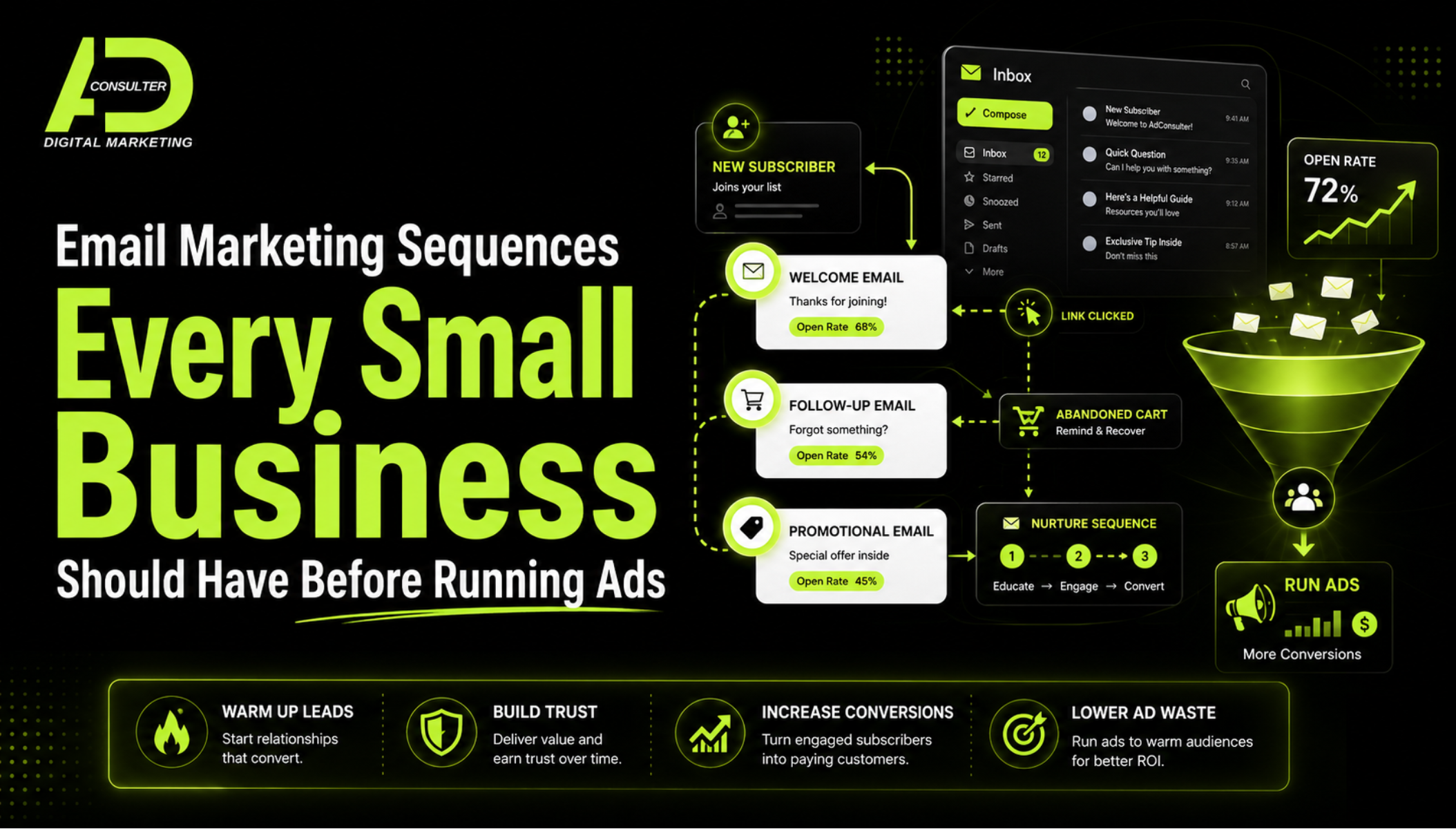
Email Marketing Sequences Every Small Business Needs Before Ads
Running ads without email marketing is like paying to bring people into a store with no one at the front desk.
You might get clicks. You might get website traffic. You might even get a few people interested. But if you do not have a system to follow up, educate, remind, and convert those people, a large part of your ad budget disappears the second they leave your website.
That is one of the biggest mistakes small businesses make. They jump into paid ads before building the follow-up system that helps turn attention into revenue.
Ads can get people to notice you. Email marketing helps you stay in the conversation.
Most customers do not buy, book, or commit the first time they discover a business. They compare. They get distracted. They check competitors. They think about it. They forget. They come back later. A strong email sequence gives your business another chance to earn their trust after that first interaction.
At AdConsulter, email marketing is built to do more than send random newsletters. The goal is to reach the right people at the right time, nurture relationships, and drive consistent engagement that leads to real conversions. If your business is planning to spend more on ads, these are the email marketing sequences you should have in place first.
1. The Welcome Sequence
The welcome sequence is the first automated email flow someone receives after joining your list, submitting a form, downloading an offer, or signing up for updates.
This sequence matters because the person is most engaged right after they take action. They just raised their hand. They showed interest. They gave you permission to keep talking to them.
If they receive one basic “thanks for signing up” email and nothing else, you lose momentum.
A strong welcome sequence should introduce your business, explain who you help, build credibility, and guide the reader toward the next step. It should feel personal, clear, and useful.
For a small business, a welcome sequence might include:
A first email thanking them and introducing your brand.
A second email explaining your main services or offer.
A third email sharing proof, results, testimonials, or portfolio examples.
A fourth email answering common questions.
A fifth email inviting them to schedule a call, request a quote, or explore your services.
For example, if someone signs up after visiting AdConsulter’s Services page, the welcome sequence can guide them toward the most relevant next step, whether that is SEO Marketing, Website Design, Email Marketing, or the All-Inclusive Marketing Package.
The welcome sequence should not overwhelm people. It should give them clarity.
2. The Lead Nurture Sequence
Not every lead is ready to buy right now.
Some people are interested but still comparing options. Some need to talk to a partner or team member. Some know they have a problem, but they are not sure which solution is right. Some are simply waiting for the right timing.
A lead nurture sequence keeps your business top of mind while that person moves closer to a decision.
This sequence should educate, build trust, and reduce hesitation. It can include helpful tips, service breakdowns, success stories, common mistakes, client results, and comparison-style content.
For example, a lead who downloads a marketing checklist could receive emails like:
“Why Your Website Is Getting Traffic But No Leads”
“How SEO Helps Small Businesses Get Found by Ready-to-Buy Customers”
“What to Fix Before Spending More on Paid Ads”
“How Email Marketing Turns Clicks Into Customers”
“Ready for a Marketing Strategy Built Around Revenue?”
Each email should naturally connect to a relevant page on the website. A website-focused email can link to Website Design. An SEO-focused email can link to SEO Marketing. A bigger-picture email can link to All-Inclusive Marketing.
The purpose is not to push hard every day. The purpose is to stay helpful until the lead is ready to act.
3. The Abandoned Inquiry Sequence
Many people start taking action and then stop.
They visit your pricing page. They click your contact button. They begin filling out a form. They look at your services. They hover around your booking page but do not schedule.
That does not always mean they are not interested. It might mean they were busy. It might mean they had one unanswered question. It might mean they needed more proof. It might mean they were interested but not confident enough yet.
An abandoned inquiry sequence helps bring those people back.
The first email can be simple and friendly:
“Still thinking about improving your marketing? Here is where to start.”
The second email can answer common questions:
“What happens after you schedule a free strategy call?”
The third email can offer proof:
“See how the right strategy can turn marketing into revenue.”
The fourth email can make the CTA clear:
“Book your free 15-minute strategy call today.”
This is where a direct link to Schedule a Free 15-Minute Strategy Call becomes valuable. The easier the next step feels, the more likely people are to take it.
The abandoned inquiry sequence works because it assumes people are busy, not uninterested.
4. The Service Education Sequence
Some businesses lose leads because prospects do not fully understand what they offer.
This is especially true for digital marketing. A potential client might know they need “more leads,” but they may not know whether they need SEO, social media, email marketing, PPC, website design, or a full strategy.
A service education sequence helps people understand their options.
For AdConsulter, this sequence could break down the core services one by one:
Email 1: Why social media consistency builds visibility and trust.
Email 2: How SEO helps customers find you when they are already searching.
Email 3: Why email marketing keeps leads warm after they leave your site.
Email 4: How a stronger website turns visitors into inquiries.
Email 5: Why an all-inclusive marketing plan connects everything into one strategy.
Each email should be simple, practical, and focused on the customer’s problem.
For example, an email about SEO should not just say, “We offer SEO.” It should explain that if customers cannot find your business, they cannot choose your business. Then it can link to SEO Marketing.
An email about website design should explain that a website should not just look good. It should be responsive, mobile-optimized, SEO-friendly, and built to convert visitors into customers. Then it can link to Website Design.
The service education sequence helps prospects self-identify. They begin to see which service fits their situation.
5. The Post-Call Follow-Up Sequence
A great sales call can still go cold without the right follow-up.
After someone books a strategy call, they may be interested, but they still need reminders, recap, proof, and next steps. A post-call email sequence helps keep that momentum alive.
The first email should be personal. Thank them for taking the call. Recap what was discussed. Explain what happens next.
The second email can link to the most relevant service or package. If they need a full strategy, send them to All-Inclusive Marketing. If they need a website, send them to Website Design. If they need a custom plan, send them to Pricing.
The third email can answer objections. Talk about timelines, onboarding, what is included, how reporting works, and how strategy is customized.
The fourth email can create a gentle check-in:
“Do you want us to put together the next step for your business?”
This sequence does not need to be pushy. It just needs to be organized.
Many businesses lose deals not because the prospect said no, but because the follow-up was weak.
6. The Review and Referral Sequence
Email marketing is not only for leads. It is also for current and past customers.
A review and referral sequence helps turn happy clients into stronger credibility for your business.
After a successful project, campaign win, website launch, or strong monthly report, send a simple email asking for feedback. If the feedback is positive, follow up with a review request. Then ask if they know another business that could use the same support.
The sequence can be simple:
Email 1: “How did everything go?”
Email 2: “Would you be willing to share a quick review?”
Email 3: “Know another business that needs better marketing?”
This type of sequence helps build testimonials, case studies, and referrals.
AdConsulter already has a Portfolio page that shows proven digital marketing work. A review and referral sequence helps create more proof that can support future sales, website credibility, and social content.
7. The Re-Engagement Sequence
Every email list has people who stop opening.
That does not mean they are worthless. It means they need a different message.
A re-engagement sequence is designed to wake up inactive contacts before you remove or suppress them.
This sequence might include:
A “still interested?” email.
A helpful marketing tip.
A new service update.
A limited-time consultation reminder.
A final check-in before removing them from regular emails.
For AdConsulter, a strong re-engagement email could say:
“Still looking for a better way to turn marketing into revenue?”
Then it can link to the Services page or invite them to schedule a free 15-minute strategy call.
The goal is to give inactive subscribers a reason to come back.
8. The Promotional Sequence
Promotional emails can work extremely well, but they should not be the only emails a business sends.
If every email is “buy now,” people tune out. But when promotional emails are mixed with education, helpful tips, proof, and relationship-building content, they feel more natural.
A promotional sequence should focus on one offer.
For example, if AdConsulter is promoting the All-Inclusive Marketing Package, the sequence can explain:
What the package includes.
Who it is best for.
Why replacing multiple retainers with one plan can simplify marketing.
How social media, SEO, website support, email, link building, and PPC work together.
Why the free strategy call is the best first step.
The strongest promotional emails do not just announce an offer. They explain the problem the offer solves.
Why Email Should Come Before More Ad Spend
Paid ads can help people discover your business, but email helps convert that attention over time.
Without email, you depend too much on immediate action. Someone clicks, visits, gets distracted, and leaves. That is it.
With email, the journey continues.
They can receive a welcome sequence. They can learn more about your services. They can see proof. They can get reminders. They can come back when the timing is better.
This is why email marketing improves the performance of other channels. SEO traffic can become email subscribers. Social media followers can join your list. Paid ad leads can be nurtured. Website visitors can be brought back. Past customers can be reactivated.
Email gives your marketing system memory.
Final Thoughts
Before you spend more money on ads, make sure you have a follow-up system that can turn clicks into conversations.
A strong email marketing strategy should include welcome emails, lead nurture, abandoned inquiry recovery, service education, post-call follow-up, review requests, re-engagement, and promotional campaigns.
When these sequences work together, your business does not have to rely on one click, one visit, or one chance. You create a system that builds trust over time.
If you want help building emails that connect to your website, ads, SEO, and sales process, explore AdConsulter’s Email Marketing, Website Design, and All-Inclusive Marketing services.
Ready to build an email system before spending more on ads? Schedule your free 15-minute strategy call with AdConsulter.
FAQs
What email sequence should a small business start with?
Start with a welcome sequence and a lead nurture sequence. These help new subscribers understand your business, build trust, and take the next step.
Should I run ads before setting up email marketing?
You can, but it is smarter to have email follow-up in place first. Ads create traffic, while email helps nurture and convert leads who are not ready immediately.
How can AdConsulter help with email marketing?
AdConsulter can help with campaign planning, segmentation, automated flows, email creative, performance tracking, A/B testing, and email strategies that connect with your website, SEO, and paid campaigns.
.png)