May 27, 2026

Backlinks for Small Businesses: Build SEO Authority Without Spam
Backlinks are one of the most important parts of SEO, but they are also one of the most misunderstood.
Many small business owners know backlinks matter, but they do not know how to get them the right way. Some ignore backlinks completely. Some buy cheap links from random websites. Some send generic outreach emails that never get replies. Some assume backlinks are only for big brands with huge budgets.
The truth is simple: small businesses can build backlinks without spam.
They just need a smarter strategy.
A backlink is a link from another website to your website. Search engines can treat quality backlinks as a signal of trust, credibility, and authority. If other relevant websites are linking to you, it can help your website become more competitive in search.
But quality matters more than quantity.
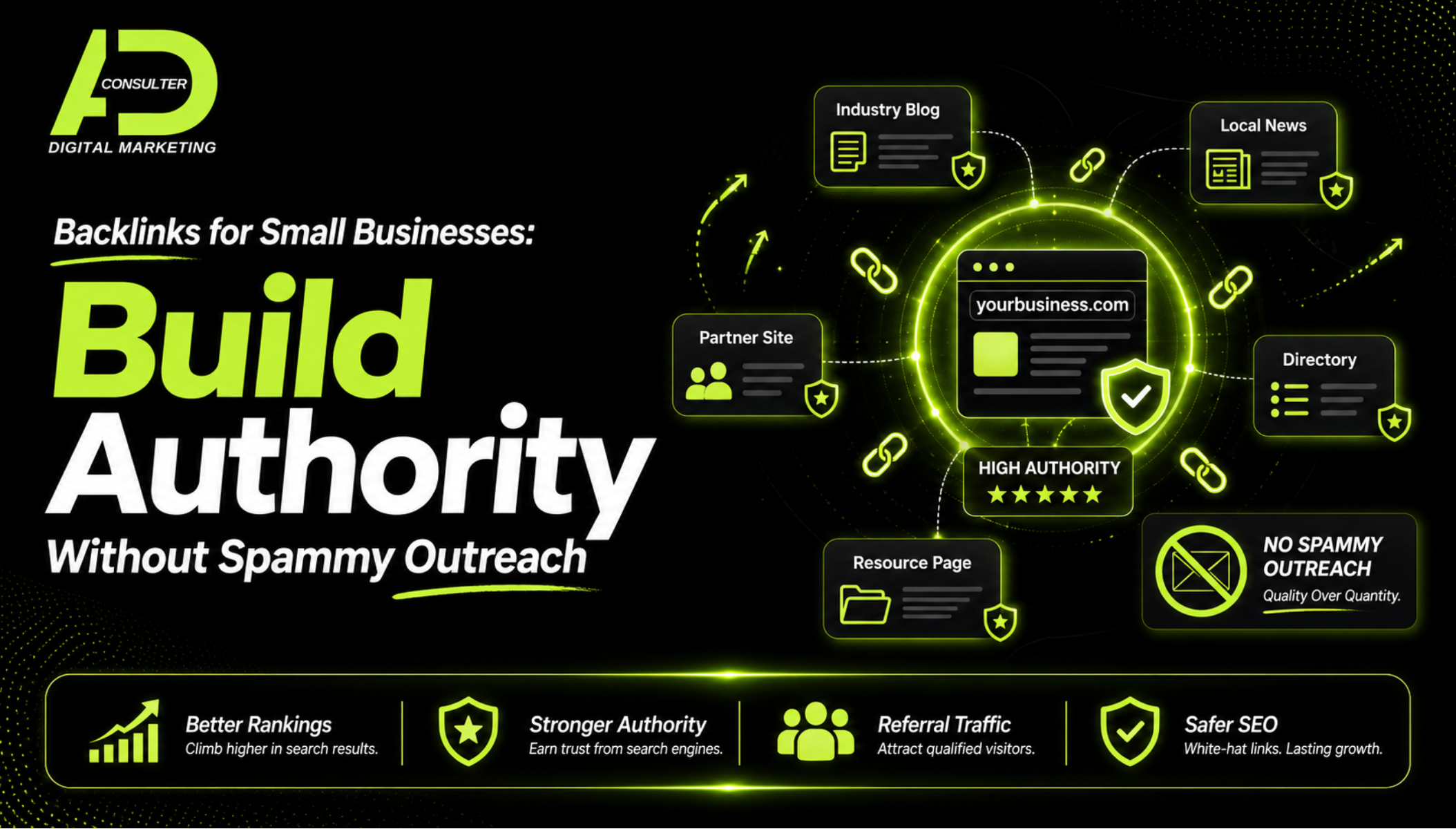
One relevant backlink from a trusted website can be more valuable than dozens of random low-quality links. Backlink building should not be about tricking search engines. It should be about building real authority around your business.
At AdConsulter, backlink strategy is part of a bigger SEO system. The goal is not just to collect links. The goal is to help your business rank higher, get found faster, bring in the right traffic, and turn visibility into conversions.
Why Backlinks Matter for Small Business SEO
SEO is competitive.
Even if your website looks great and your service pages are optimized, your competitors may still outrank you if they have stronger authority.
Backlinks help build that authority.
They can support:
Higher search visibility.
More organic traffic.
Stronger trust signals.
Better rankings for service pages.
Referral traffic from other websites.
More credibility in your industry.
More local or niche relevance.
For small businesses, backlinks can be especially helpful because they give search engines more signals that your business is real, relevant, and worth showing.
But backlinks do not work alone. They work best when your website is already strong.
That means you need optimized service pages, helpful content, fast loading speeds, clear structure, and strong calls to action. AdConsulter’s SEO Marketing service connects backlink outreach with keyword research, technical SEO, on-page optimization, content strategy, and performance tracking.
That full approach matters because backlinks should support a website that is ready to convert.
The Problem With Spammy Backlink Tactics
Spammy backlink tactics often promise fast results.
They may include buying hundreds of links, using link farms, submitting to low-quality directories, posting irrelevant comments, or publishing thin guest posts on random websites.
These tactics can create more problems than progress.
Low-quality backlinks can make your website look untrustworthy. They can also bring no real referral traffic, no brand value, and no meaningful authority. Even worse, they can distract you from building a strategy that actually lasts.
Spammy outreach also damages your reputation.
If you send generic emails to hundreds of website owners asking for links with no value in return, most people will ignore you. Some may see your brand as unprofessional.
The better approach is to earn and build backlinks through relevance, relationships, helpful content, and real business activity.
Start With a Website Worth Linking To
Before you ask anyone to link to your website, ask this:
Is there anything on my website worth linking to?
If your website only has a homepage, a basic services page, and a contact form, backlink building will be harder. People need a reason to link.
Strong link-worthy pages can include:
Helpful blog posts.
Detailed service pages.
Case studies.
Portfolio examples.
Guides.
Checklists.
Original insights.
Industry resources.
Local resource pages.
Client success stories.
AdConsulter’s Portfolio page is a strong trust-building asset because it highlights proven digital marketing work. Service pages like SEO Marketing, Website Design, and Email Marketing also give visitors clear pages to understand what the agency does.
The stronger your website is, the easier it becomes to earn links.
Create Blog Content That Answers Real Questions
Helpful blog content is one of the best ways for small businesses to attract backlinks.
People link to content that answers a question, explains a topic clearly, or gives readers something useful.
For example, a marketing agency can create blogs like:
“Why Your Website Is Not Getting Leads”
“How SEO Works for Service Businesses”
“What to Fix Before Running Paid Ads”
“Email Sequences Every Small Business Needs”
“How to Build a Full-Stack Digital Marketing Strategy”
These topics are useful because they answer real business questions.
AdConsulter’s Blog is the right place to build this type of authority. Every blog should have a purpose. It should support a service, answer a search question, or help move readers closer to becoming leads.
A blog should not just exist to add words to your website. It should be useful enough that someone would share it, cite it, send it to a client, or link to it from another page.
Use Internal Links Before You Chase External Links
Backlinks are important, but internal links are also powerful.
An internal link is a link from one page on your website to another page on your website. Internal links help users navigate your site and help search engines understand which pages matter most.
For example, a blog about backlinks should link to SEO Marketing. A blog about website conversions should link to Website Design. A blog about connected marketing should link to All-Inclusive Marketing.
Internal links help distribute authority across your website.
If a blog earns backlinks but does not link to any important service pages, you are missing an opportunity. The authority coming into that blog should help support your business pages too.
Before chasing more backlinks, make sure your own site is connected properly.
Get Listed in Relevant Directories
Directories can still be useful, but only when they are relevant and trustworthy.
Small businesses should avoid spammy directories that exist only to sell links. Instead, focus on directories that real people use.
These may include:
Local chamber of commerce listings.
Industry associations.
Professional directories.
Niche marketplaces.
Local business directories.
Partner directories.
Software or vendor partner pages.
Community organization pages.
The key is relevance.
If the directory makes sense for your location, industry, service, or audience, it may be worth pursuing. If it looks random, low-quality, or unrelated, skip it.
Directory links are not a complete backlink strategy, but they can help create a strong foundation.
Use Business Relationships to Build Links
Many small businesses already have backlink opportunities around them. They just have not asked.
Think about the relationships your business already has:
Vendors.
Clients.
Partners.
Local organizations.
Event hosts.
Podcast hosts.
Professional groups.
Sponsorships.
Collaborators.
Software tools.
Industry peers.
If your business sponsors an event, the event website may link to you. If you guest on a podcast, the show notes may link to your website. If you provide a testimonial to a vendor, they may link back to your company. If you partner with another business, you may be able to create a joint blog, case study, or resource.
These backlinks are strong because they come from real relationships.
They make sense.
Turn Client Work Into Case Studies
Case studies are excellent backlink assets because they show real results.
A strong case study can explain:
The client’s challenge.
The strategy.
The execution.
The results.
The lesson.
AdConsulter already highlights success stories and portfolio examples across PPC, SEO, social media, local visibility, organic traffic, engagement, and lead generation. Turning some of those examples into deeper case-study-style blog posts could create stronger assets for SEO and outreach.
Case studies also help sales.
Even if a case study does not attract backlinks immediately, it gives prospects proof that your business can do what it says.
Backlinks build authority. Case studies build trust. Together, they are powerful.
Try Guest Content the Right Way
Guest content can still work, but only when it is done well.
The wrong way is to send a generic pitch to hundreds of websites asking if you can “contribute high-quality content” just to get a backlink.
The right way is to find relevant websites with audiences that would actually benefit from your expertise.
For a small business, guest content opportunities might include:
Local business blogs.
Industry publications.
Partner websites.
Professional associations.
Niche newsletters.
Podcast websites.
Community publications.
The pitch should be specific. Explain the topic, why it fits their audience, and what value you can provide.
A strong guest article should be helpful even if the link was removed. That is how you know the content has real value.
Use Digital PR Angles
Digital PR means creating stories, insights, or resources that other websites may want to mention.
You do not need to be a giant brand to use digital PR. Small businesses can use it too.
Possible digital PR angles include:
A new service launch.
A local business milestone.
A helpful industry guide.
A community initiative.
Expert commentary.
A trend report.
A unique opinion on a common problem.
A case study with a strong result.
For AdConsulter, digital PR angles could focus on small business marketing, AI-supported marketing systems, website conversion, SEO for service businesses, or how connected marketing helps businesses replace scattered vendors with one strategy.
The best PR angles are not just about saying, “Look at our business.” They connect your expertise to something useful, timely, or interesting.
Build Links Through Helpful Resources
Resource pages are another backlink opportunity.
Many websites link to helpful tools, guides, templates, or educational pages. If your business creates something useful, you can reach out to relevant websites that may want to include it.
For a marketing agency, useful resources might include:
A small business website checklist.
An SEO audit checklist.
An email sequence planner.
A local SEO guide.
A landing page conversion checklist.
A social media content calendar template.
These resources can live on your website and support SEO, lead generation, email list building, and backlink outreach.
A strong resource gives people a real reason to link.
Avoid Over-Optimized Anchor Text
Anchor text is the clickable text in a link.
For example, in the link SEO Marketing, the anchor text is “SEO Marketing.”
Anchor text helps search engines understand what the linked page is about. But if too many backlinks use the exact same keyword-heavy anchor text, it can look unnatural.
A natural backlink profile includes a mix of branded anchors, URL anchors, general anchors, and descriptive anchors.
Examples might include:
AdConsulter.
AdConsulter’s SEO services.
This SEO marketing guide.
Learn more here.
Digital marketing agency.
A natural mix is better than forcing the same keyword every time.
Track Backlink Quality
Backlink building should be tracked.
You want to know:
Which websites link to you.
Which pages they link to.
Whether the websites are relevant.
Whether the links are high quality.
Whether organic traffic is improving.
Whether rankings are moving.
Whether leads are increasing.
AdConsulter’s SEO Marketing includes performance tracking and monthly reporting, which is important because SEO should be measured over time.
Backlinks are not the only metric that matters. They should be viewed alongside keyword rankings, organic traffic, website conversions, and lead quality.
Common Backlink Mistakes Small Businesses Make
The first mistake is buying cheap backlinks.
The second mistake is ignoring backlinks completely.
The third mistake is building links to a weak website.
The fourth mistake is only linking to the homepage.
The fifth mistake is forgetting internal links.
The sixth mistake is sending generic outreach emails.
The seventh mistake is focusing on quantity instead of quality.
The eighth mistake is not tracking what links are actually doing.
Backlink building does not have to be complicated, but it does need to be thoughtful.
A Simple Backlink Plan for Small Businesses
Start with your website.
Make sure your homepage, service pages, blog posts, portfolio, and contact page are clear and professional.
Next, create a few link-worthy assets. These could be guides, checklists, case studies, or helpful blog posts.
Then, look at your existing relationships. Ask where links would naturally make sense.
After that, build a small list of relevant directories, partners, podcasts, local organizations, and industry websites.
Then begin personalized outreach.
Finally, track your progress monthly.
This process is slower than buying links, but it is much stronger.
Final Thoughts
Backlinks can help small businesses build authority, improve rankings, and attract more organic traffic. But the goal should never be spammy outreach or shortcuts.
The goal should be trust.
Build a website worth linking to. Publish helpful content. Strengthen internal links. Use real relationships. Create case studies. Pursue relevant directories. Share useful resources. Track quality over time.
That is how small businesses build authority without damaging credibility.
If your business wants a stronger SEO strategy that includes backlinks, content, technical improvements, and reporting, explore AdConsulter’s SEO Marketing and All-Inclusive Marketing services.
Ready to build authority without spammy outreach? Schedule your free 15-minute strategy call with AdConsulter.
FAQs
Are backlinks still important for small business SEO?
Yes. Quality backlinks can help small businesses build authority, improve search visibility, and support stronger rankings when paired with good content and technical SEO.
What makes a backlink high quality?
A high-quality backlink comes from a relevant, trustworthy website and points to a useful page on your site. It should make sense for readers, not just search engines.
How can AdConsulter help with backlinks?
AdConsulter can help with backlink outreach, SEO strategy, content creation, internal linking, technical SEO, and performance reporting to build authority in a more sustainable way.
.png)